

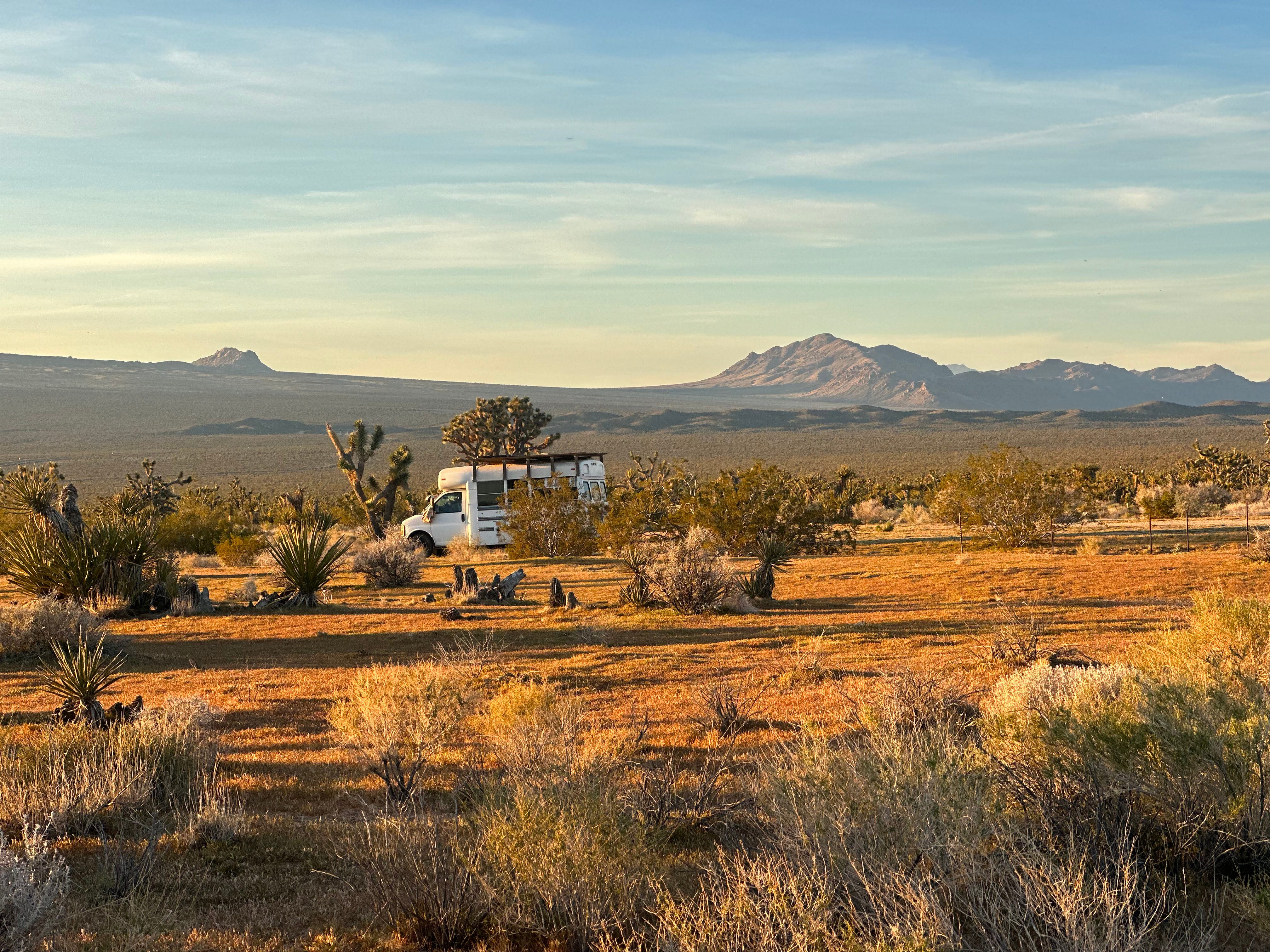
Hello, friends. I’m writing to you on this full moon from the Spring Mountains just north of Las Vegas, Nevada, after a week in the Mojave National Preserve.
I’ve moved to higher elevations as the lower desert valleys have been warming.
Before the heat hit, I was camped near the Algodones Dunes Wilderness west of Yuma, Arizona, and at the Salton Sea in California. I met other travelers in both places which I’ll write about soon.
I’ll also begin posting shorter Field Notes in between. There is so much to share…
The Mojave National Preserve is a remote desert wilderness filled with vast bajadas, rugged mountains, and Joshua Tree forests that stretch for miles, larger, even, than in Joshua Tree National Park. With hotter, drier weather, and less rainfall due to climate change, many Joshua Trees have been dying at lower elevations as they rely on specific moisture levels and cold temperatures for their life cycle. So, in their infinite wisdom, the trees are slowly migrating north, seed by seed.
As artist-researcher Juniper Harrower cautions, however, their survival is still fragile and uncertain; the trees are mutually dependent on a single species of yucca moth for pollination, and the moths are not as active in the upper regions of the Mojave Desert.
The desert is named for the Mojave Indian Tribe, or Pipa Aha Macav, “The People By The River,” original stewards of this land.
Like the Joshua Trees, the Pipa Aha Macav were also displaced by changing conditions due to colonialism, and faced cultural erasure by the US government. Today, the Tribal Nation is healing and creating opportunities for families to thrive on reservation land spanning Arizona, California, and Nevada on the banks of the Colorado River.1
Rough Roads May Exist
While hiking into Cedar Canyon in the Preserve, I came across this sign:
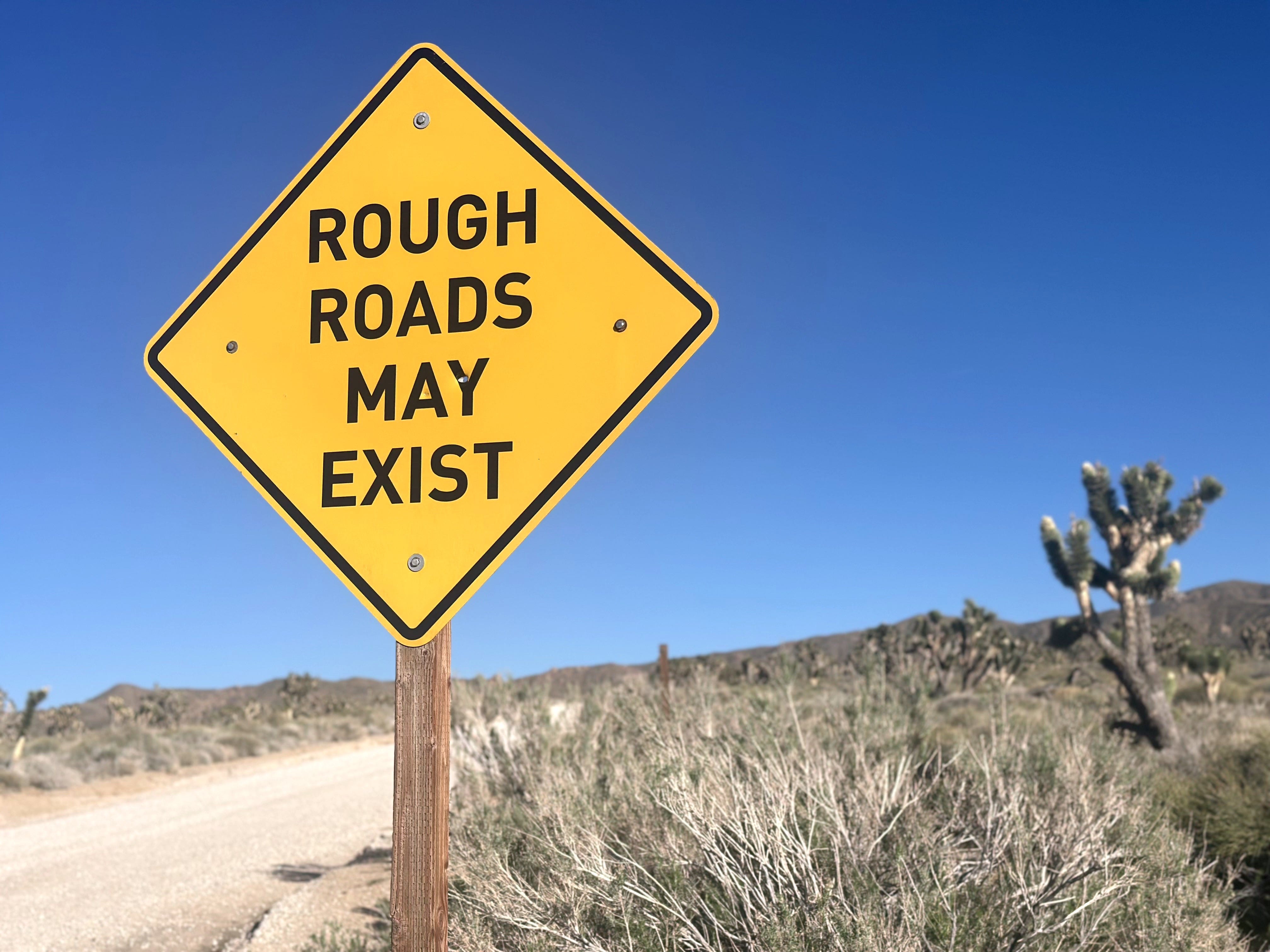
Indeed.
As a friend said wryly when I showed her, “No Doubt.”
In the wilderness, though, it’s an important warning, a vital heads up.
It means: Slow Down. Pay Attention. Take Good Care.
This is not to be taken lightly. There’s no cell signal in this part of the Mojave Desert. Getting stranded due to a broken axle or blown tire is more than inconvenient – the combination of heat and solitude can be life-threatening.
When I’m driving and see a sign like this, I automatically do a safety check:
Does the bus have high enough clearance? Are my tires in good shape? How much fuel is in the tank? If I get stuck, do I have what I need to get unstuck? Do I have enough food and water in case I’m stranded awhile? Does my emergency contact know where I am?
Even when walking, it’s a reminder of the risk. During my hike, another traveler in a pickup truck stopped to make sure I was ok. He peered at my pack and asked if I had enough water. It’s rare to see someone walking alone here and often signals a vehicle breakdown.
I had plenty of water with me and other emergency gear, though I was grateful for his care.
Desert dwellers look out for each other.
As I walked further into the Joshua Trees and brittle bush, I thought about another interpretation of the sign:
Rough Roads May Exist
May. As in maybe. But maybe not.
We won’t really know until we get there.
How many of us, anticipating a rough road, a rough day, a rough conversation, automatically brace ourselves or start to worry out of fear of how things might go.
Or we catastrophize, predicting it’s going to be awful. Or, at least, not fun.
As we’ve likely all discovered, this just makes things worse, before we even get there. Which also makes us less resilient and less able to respond well to whatever may come. Or to help others. The story we tell ourselves about the road ahead changes our experience of the road itself.
It’s a variation on what physicist John Wheeler called “the participatory universe,” following Niels Bohr and Max Planck’s work in quantum mechanics. “We weave the fabric of the universe,” Wheeler said, “out of billions upon billions of acts of observer-participancy.”
Is the road actually rough, or is it us?
In Zen, we call this the second arrow. There’s what’s happening – we read a sign that says “Rough Roads May Exist” – and then there’s the feedback loop with all the feelings, preferences, ideas, and judgments that arise in us about what is happening. I did a drawing once of all the extra arrows I was adding to a situation – well over 40 arrows! None were based in reality.
This is where meditation and mindfulness practice can be very practical. It helps me do what the sign tells me to do: Slow Down. Pay Attention. Take Good Care.
As in, take good care of my mind. I’ve realized if I don’t take care of my mind on a regular basis, it quickly goes sideways and starts making up all kinds of things.
But when I slow down and pay attention to whatever I’m experiencing – including fear – I’m not caught by the feedback loop as much. I can stay open to whatever arises and respond as needed. As the saying goes, I don’t make a mountain out of a molehill.
So, Rough Roads May Exist.
But maybe not.
Then again…
Maybe so.
Some roads are, indeed, rough.
No spiritual bypassing here. Sometimes a mountain is actually a mountain. And we have to make our way over the rocks and through the pass.
Life is going to be rough for all of us - humans, Joshua trees, yucca moths - at some point. It may be for you right now.
A dear friend of mine is going through cancer treatment. Every day, she and her husband drive an hour to the Cancer Center for radiation, tests, and consultations with the docs and then back home. Only to return the next day to do it all over again. Although the treatment seems to be helping, it is painful and all-consuming.
Another friend in Minneapolis-St. Paul shared with me today how exhausted and frayed everyone is there. They have been living through months of vigilance, community organizing, and safety patrols to protect immigrants, school children, and each other from unlawful ICE detentions and violence during Operation Metro Surge and in the weeks afterward.2
For many, rough is a privileged understatement. Especially those who are unsheltered, hungry, or at risk of being displaced or killed, or have experienced abuse or trauma in their life.
The world is also becoming increasingly more unstable and unpredictable. From forests dying to war and violent conflict on the rise to the everyday trials of being human and being alive, this sign is a vital reminder for all of us:
Slow down. Pay Attention. Take Good Care. Look out for one another.
The truth is, we don’t ever know what the road ahead will bring.
Some roads we think are going to be fine, aren’t.
Two weeks ago, as I was driving on I-15 toward Las Vegas on a beautiful sunny Nevada morning — BANG!!!, a huge blast suddenly rocked the bus. I grabbed the steering wheel as a tire tread flew down the highway in my rearview mirror. I was able to pull off safely at an exit ramp into a Chevron station and took a look at the damage.
Fortunately, it was one of the rear tires and the Elephant is a dually (double rear wheels). If it had been one on the front, things might have gone a lot differently. But still… scary!
Within a few hours, Giovanni with LV Road Tec Semi Truck Repair came to the rescue with a new tire, and I had enough in my emergency fund to take care of what was needed.


.
The cats and I were back on the road later that afternoon. But it certainly wasn’t the day I expected.
I had hoped to get through Las Vegas and into the mountains before the temperature got too hot. Instead, we ended up stuck in bumper-to-bumper traffic downtown at 4pm next to the Mandalay Bay Casino. With no AC in the Elephant, it was well above 100°F inside. I poured water over my head and soaked Mieko’s fur to cool us both off (he rides on my lap). Thomas tucked himself in the shoe closet where he was more protected from the heat.
We made it to a camp spot just as the sun set; “rode hard and put up wet” as they say in Texas. It was quite the wild ride, to say the least.
Throughout my pilgrimage, I’ve learned things can change at any moment. To let go of any expectations. And to find the excitement in the uncertainty. I wonder what’s going to happen next?!
Some days I’m better at that than others.
My mother lived in fear of uncertainty her whole life. She would collapse into tears or rage if something felt out of her control or went wrong. Not surprising, as she was often abused by her mother as a child and felt little safety in her early life. Sadly, she never had the opportunity to heal from this trauma, though she did find some comfort in being with animals. It was much easier for her to relate with them than with people, I think.
In her later years, she rarely went out of the house to keep things as safe and predictable as possible.
Rough roads in life are inevitable, though. Personally, collectively, globally.
I’ve learned through her life and my own that if I try to avoid it, brace against it, get angry, suppress my feelings, or catastrophize, I’m just making things harder on myself and others.
There’s only so long we can argue with reality.
Reality always wins.
And the road is still the road.
Where might it take us? What might it have to show us?
One of my closest friends went through a difficult break up recently with her long-term partner. She knew she needed to end the relationship for awhile but couldn’t bring herself to do it – she cares for him deeply and didn’t want to hurt him. She was also afraid of how he might react and didn’t know if she would be ok living on her own.
In the meantime, despite seeing counselors and trying to work through things, they grew more stagnant, impatient, and resentful with each other. Feeling stuck, my friend was unable to sleep at night. And started isolating at home in despair during the day.
Eventually, out of desperation, she had the hard conversation she needed to have. Afterward, she called me, sobbing. And is now facing the painful logistics of disentangling two lives deeply entwined with each other.
Amidst the difficulty, though, there is healing.
For both of them, who I love dearly.
They are each moving forward in ways they couldn’t manage to figure out together. And, though weepy and wobbly, as she puts it, my friend sees how resisting out of fear had blocked her energy and created her despair. By accepting the change that felt inevitable, she is now experiencing more spaciousness and freedom in her heart, with gratitude for all that life has to offer. She has been meeting up with friends, playing music, mulching the garden, and just landed a new client project.
Although what comes next is still uncertain, she feels hopeful, lighter and more at peace. The path she dreaded turned out to be the greatest gift.
How often do we make the road rougher than it needs to be?
Or avoid it altogether and miss out on where it might lead?
Down the many rough roads I’ve been on in the White Elephant, I’ve found the most sacred places. Secret soaking pools above Sitting Bull Falls. The Needle at the crest of Gold Canyon in the Superstition Mountains.
And now, the Joshua Trees of the Mojave Desert, on a pilgrimage of their own.


A sign of wisdom
There is a famous Zen koan, “How do you go straight on a road with 99 curves?”
When working with koans, the practice is to “become the koan.” When on a road with 99 curves, be on a road with 99 curves. Fully. What’s that like? How does that feel?
Wisdom is meeting the road that is, just as it is. Not the road that we think will be. Or another road we wish we were on instead.
Compassion is accepting, wholeheartedly, that right now, it’s like this, and taking care of whatever is needed.
Last Thursday, a devastating fire destroyed the historic wooden meditation hall at Tassajara in Big Sur, California, one of the oldest Zen Buddhist monasteries in the US. The zendo collapsed and burned to the ground along with a 2000-year-old Buddha statue that survived a previous fire and other irreplaceable relics. Monks and residents fought the flames but were unable to extinguish them in time.
After an initial post on social media by the Sangha about the terrible loss, the Abbot shared this message on Tuesday:
Good morning. Tassajara practice continues uninterrupted. The Sangha is resilient. Monks sit zazen now in the Retreat Hall. Canyon wrens sing on the Kaisando roof in the morning, frogs chant along Carvaga Creek at night. Gratitude to the Buddhas and Ancestors, the mountains and waters, for this liberative Way of life.
As the Irish Blessing goes, may the road rise up to meet you.
And, like the wise Joshua Trees, the Pipa Aha Macav, the monks… may we meet the road that is, together.
♥️
—
Images by Sam Sokyo.
You can visit the Fort Mojave Indian Tribe website here and learn more about their culture and history here.
Las Vegas Weekly article on current tribal developments: Native Americans in Southern Nevada build for the future as they keep their traditions alive.
You can Stand with Minnesota and support the human rights of immigrants, refugees, and asylum seekers throughout the US with the National Immigrant Justice Center.
Beautiful, Sam, and helpful. Thank you.
Storytelling is one of the oldest forms of communication, and Sam, you have the creative writing spirit to do just that.